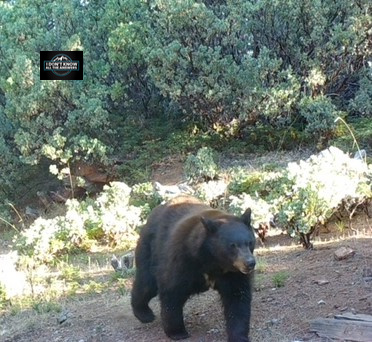
It was an ordinary day in Arnold, California, when an extraordinary encounter unfolded outside my home. Living in a place where wildlife roams freely is a privilege, and I had taken to documenting it with a network of cameras installed around the house. That day, the cameras alerted me to the presence of a black bear directly under my deck. Neither frightened nor cautious—just excited—I rushed outside, leaning over the railing to get a closer look.
The bear, a magnificent figure, stood out in stark contrast against the earthy tones of the landscape. I found myself staring directly into its eyes, captivated by their depth and seemingly intelligent gleam. My immediate thought was how special and rare this moment was, a literal “once in a lifetime” encounter.
But the bear didn’t stay still for long. It sauntered calmly toward a nearby pine tree and, to my surprise, stood up on its hind legs. It pressed its back against the bark and began to rub up and down as if scratching an itch. This, I assumed at the time, was the bear’s way of showing that it was comfortable. Emboldened, I did something foolish—I waved at the bear and called out, “Hi, Honey!” I genuinely believed my actions conveyed friendliness, but in hindsight, I understand how misguided and naïve I was.
However, I recently listened to a podcast featuring an Animal behaviorist discussing black bear behavior, and what I did, even though it was unintentional, was not conveying friendliness to this bear. Because I now regret my actions entirely, having become more informed. I wanted to share with you once again what I did and what I should’ve done.
Learning to Respect Wildlife
What felt magical to me likely felt stressful to the bear. By leaning over my deck and making direct eye contact, I inadvertently behaved in ways that could have been perceived as threatening. The bear’s behavior—its movement to the tree and the rubbing—may have been its way of asserting confidence or masking unease.
Looking back on that moment, I’ve had to confront my misconceptions. Observing a wild animal isn’t about creating an intimate connection or seeking acknowledgment. It’s about respecting boundaries—something I failed to do that day. Encounters like that are rare gifts, but they come with responsibility, a lesson I carry with me every time I see wildlife now.
If you’re captivated by bears, as I am, you might wonder how to observe these incredible creatures responsibly. It begins with knowing how to strike a balance between curiosity and respect.
Practical Tips for Observing Black Bears Responsibly
1. Keep a Safe Distance
Even when observing wildlife from the comfort of your own home, maintaining a safe distance is key—100 yards is the recommended minimum when it comes to black bears. No excited gestures or calls can replace this need for space. If you’re looking for a closer view, binoculars or a spotting scope are your best tools.
2. Use Technology to Your Advantage
My house cameras allowed me to know the bear was nearby before I even saw it. If you live in bear country, having equipment like motion-activated cameras provides a helpful heads-up while ensuring you don’t accidentally come too close.
3. Avoid Direct Eye Contact
The moment I made direct eye contact with the bear, I unintentionally crossed a line. To us, eye contact might feel like a sign of connection, but in the animal kingdom, it often signals aggression or dominance. When observing bears, keep your movements slow and steady, and avoid staring directly into their eyes.
4. Learn to Read Bear Behavior
Understanding how to recognize bear behavior can help you determine if they’re stressed or comfortable with your presence. For example, a bear standing on its hind legs is likely trying to get a better view of its surroundings—not preparing to attack. On the other hand, if a bear is huffing, snapping its jaws, or pacing, it’s time to back away. These are signs of agitation you shouldn’t ignore.
5. Never Feed or Approach Bears
It’s tempting to want to connect with animals by offering food, but feeding wildlife is one of the most harmful things you can do. Bears that associate humans with food lose their natural foraging instincts and often become problem bears, putting both themselves and humans at greater risk.
6. Secure Your Space and Belongings
If you live in bear territory, as I did, ensuring they can’t access food around your home is critical. This means securing garbage, storing bird feeders during bear-active seasons, and locking up anything that smells edible, from pet food to barbecue grills.
7. Stay Calm and Observant
Should a bear come close, don’t panic. Running or yelling will only escalate tension. Instead, speak in a calm tone and retreat slowly, ensuring you provide the bear with a clear escape route.
Reflecting on the Gift of Wildlife
That day on my deck in Arnold, what I initially felt was a deeply personal connection with a wild black bear. But with time and education, I’ve come to realize that what matters most in any wildlife encounter isn’t the connection you feel—it’s the care and respect you show.
Bears aren’t there to entertain or relate to us. They’re guardians of their ecosystems, symbols of the beauty and balance in the natural world. It’s up to us to ensure our actions honor that balance, preserving both their safety and their wildness.
The next bear I see, I’ll observe quietly, through binoculars or my cameras, from a respectable distance. I’ll be grateful for its presence, for the simple privilege of seeing a creature so magnificent just being itself.
Remember, every wildlife encounter is a story to cherish, but it’s also an opportunity to reflect on our place in the natural world. By respecting the space and autonomy of the animals we admire, we ensure their stories continue, uninterrupted and untamed.
References: