
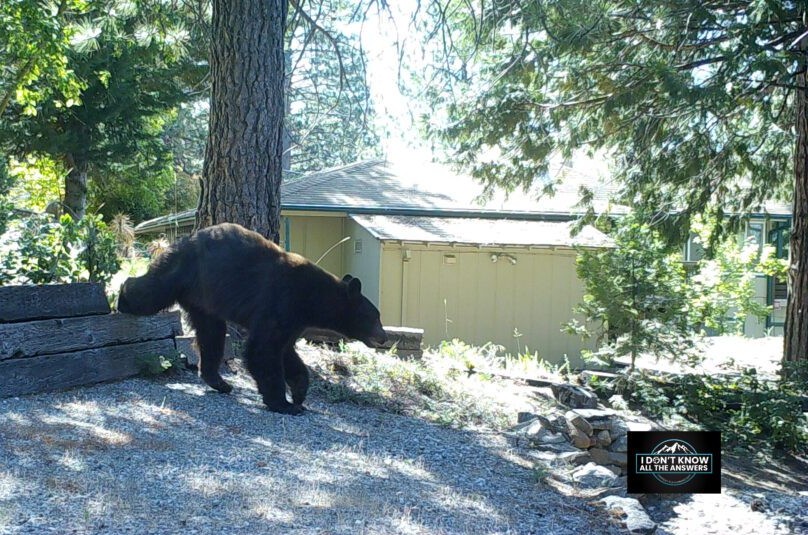
As the days grow shorter and the temperature begins its slow descent in the Sierra Nevada mountains of California, the black bears are quietly getting ready. These magnificent creatures are not merely waiting for winter to arrive. They are actively preparing, building fat stores, choosing safe dens, and adjusting their behaviors in ways that show not just intelligence, but also resilience and adaptation.
Feast Before the Freeze
From mid-August through autumn, many black bears enter a state called hyperphagia. They eat almost nonstop, foraging for high-calorie foods like acorns, berries, insects, and vegetation that can sustain them for months. During this time, some bears can increase their fat reserves by as much as 35 percent. This period of intense feeding is not simply gluttony; it is a survival strategy. In eating more now, the bears invest in the months ahead when food will be scarce and their energy needs must shift.
Smart Den Selection
As fall advances, bears begin to look for suitable den sites. In the Sierra Nevada region, they select locations that provide shelter, insulation, and security, such as crevices beneath rock piles, hollowed-out trees, root boles, or sheltered slopes. They know that the quality of their den affects how well they will weather the winter.
Not all bears in this region fully hibernate. Research shows that in the Sierra Nevada, only about a third of male black bears enter long dormancy. In contrast, many others remain active in lower elevations where snow cover is sporadic. This flexibility is not just a survival tactic but a display of remarkable intelligence. Bears adjust their behavior to local conditions rather than unthinkingly following a single pattern. Their adaptability is genuinely inspiring and leaves us in awe of their survival skills.
Changing Physiology with Purpose
Once inside their dens, bears slow their metabolism, lower their heart rate, and go for long periods without eating, drinking, urinating, or defecating. They manage to sustain themselves without losing significant muscle or bone mass; their bodies are adapted to survive the long rest. It’s like nature’s way of pressing pause while remaining alive, alert beneath the surface.
Intelligence in Every Move
Black bears are brilliant creatures, often underestimated by many. Their sense of smell, seven times more sensitive than a bloodhound’s, and their quick learning abilities in tasks of sight and shape recognition are just a few examples of their cognitive prowess. Their decisions on when and where to feed, when to den, and how to flex between dormancy and activity in the Sierra Nevada are not just survival strategies, but a testament to their cognitive flexibility and survival wisdom. Their intelligence is truly impressive and commands our respect.
Coexistence and Respect
For those of us who live or have lived near forests and foothills, the bears’ preparations serve as a crucial reminder: we share this land. As bears forage more heavily in autumn, they may be drawn into human spaces by smells and attractants. It becomes our responsibility to secure food, trash, and shelter areas to allow wild bears the space they need. Our awareness and actions are not just about our own safety, but also about the health of the entire ecosystem. We must respect the bears’ role in the ecosystem and act accordingly.
Why It Matters
Watching the bears prepare teaches us something about our own rhythms. Life often asks us to prepare, to adapt, to shift when conditions change. The bears gain wisdom from their ancestors, cubs learning from their mothers, as bear cubs follow and absorb their mother’s knowledge. Their story encourages gratitude for the ordinary, for the cycles that sustain us, and for the intelligence of nature that does not waste, but thrives.
A Closing Reflection
In the quiet forests of the Sierra Nevada, black bears remind me that preparation is not panic, and slowing down is not giving up. It is the wise embrace of change. When I see these gentle giants move through autumn, gathering weight, seeking shelter, readying for winter’s hush, I feel a gentle humility. They teach me to listen to seasons, to respect the land, and to give thanks for the deep work that happens out of sight. The bears do not make a show of readiness. They become ready. And there is grace in that.
Thank you for reading this blog post. If you have any questions or comments, please leave them in the Comments section below.
Copyright © 2019. I Don’t Know All The Answers, Nikki Mastro.
All of my photographs and documents are copyrighted.
No part of this website, including text, photographs, and documents, may be reproduced, stored in a retrieval system, or transmitted in any form or by any means without written permission from the copyright holder. All unauthorized use is strictly prohibited. If you choose to copy or share any information from my site, you must provide a link to the source. I appreciate your cooperation.
For further information concerning “I Don’t Know All The Answers.”
– Website and Blog: https://www.idontknowalltheanswers.com
– Facebook: https://www.facebook.com/Nikki.L.Mastro/
– Instagram: https://www.instagram.com/i_dont_know_all_the_answers/
– LinkedIn: https://www.linkedin.com/in/nikki-mastro-05455a3a/
– Youtube Channel: https://www.youtube.com/@idontknowalltheanswers1954