
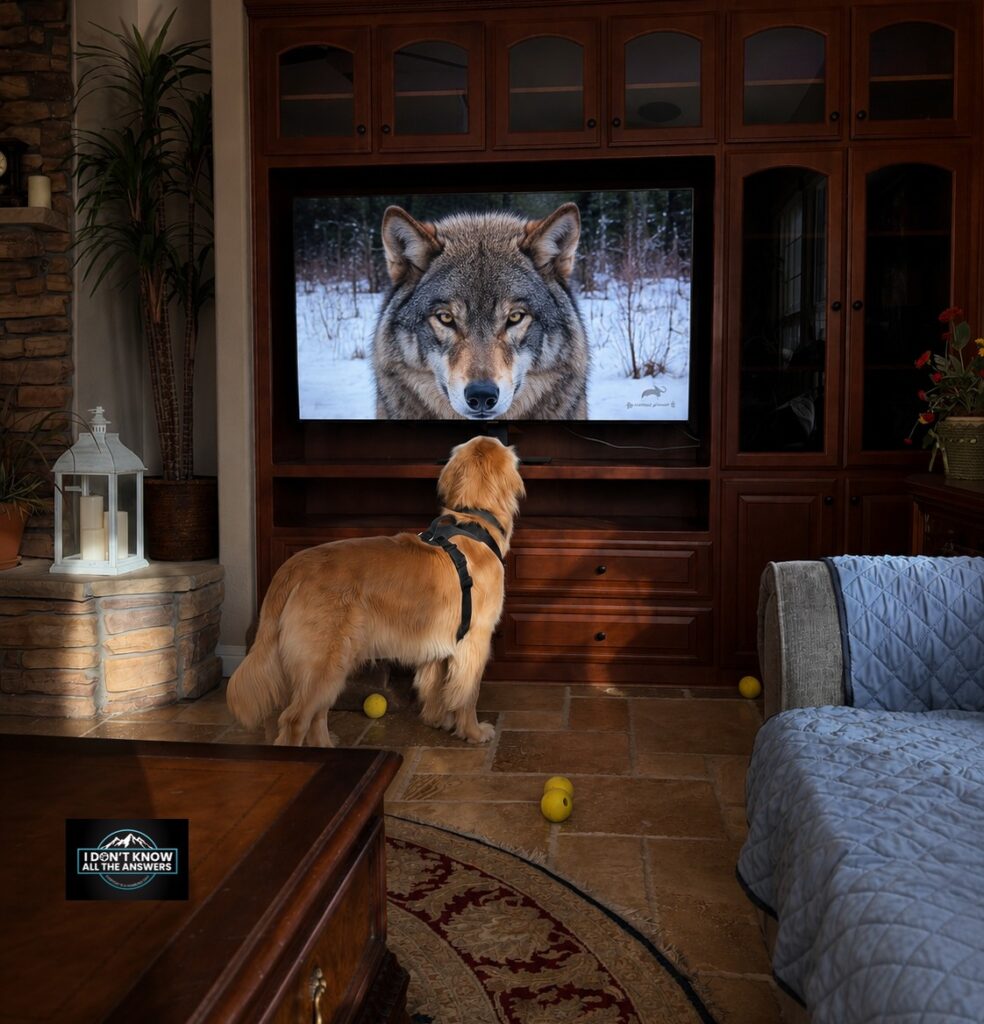
Last night, Bear surprised me.
He became alert and visibly startled. His attention locked onto the image in a way I have rarely seen. This was not the same response he gives to the dogs on Dog TV or the occasional animal that wanders across the screen during other programs. Something about this particular image captured his attention and seemed to trigger concern.
As pet parents, our first instinct might be to laugh and say, “It’s only a television.” But that led me to a different question.
Does Bear know it is only a television?
Modern research into dog cognition has shown us that dogs are far more perceptive than we once believed. They recognize familiar faces, read human emotions, respond to body language, and often detect subtle changes in our moods before we do. Scientists now recognize that dogs are highly social animals with remarkable observational abilities.
What researchers do not fully understand is exactly how dogs interpret television images.
Many dogs ignore television altogether. Others watch it with great interest. Some appear able to recognize animals, people, or situations on the screen. Yet it is entirely possible that a dog’s understanding of a television image is different from our own. Humans learn from an early age that the people and animals we see on a screen are not physically present. Dogs may not always make that distinction.
The first is that he genuinely perceived the wolf as a potential threat. Wolves and dogs share a common ancestry, and wolves possess physical characteristics that signal danger. The direct stare, large size, upright posture, and intense eyes may have activated instincts that caused Bear to pay attention.
The second possibility involves those striking yellow eyes. Bear has watched many dogs on television before, including huskies and other northern breeds. Yet this wolf looked different. Dogs see color differently from humans, but they can distinguish yellows and blues quite well. Perhaps those bright yellow eyes stood out in a way that immediately captured his attention.
A third possibility is that the wolf appeared unusually large. On a big television screen, the animal may have looked larger than many real dogs Bear encounters. If he interpreted the image as a living creature, he may have been evaluating whether this newcomer was a friend or a potential threat.
What I do know is that his reaction was real.
From Mom:
Thank you for reading this blog post. If you have any questions or comments, please leave them in the Comments section below.
Copyright © 2019. I Don’t Know All The Answers, Nikki Mastro.
All of my photographs and documents are copyrighted.
Note: I used AI (ChatGPT) to recreate the main image for this Blog post.
No part of this website, including text, photographs, and documents, may be reproduced, stored in a retrieval system, or transmitted in any form or by any means without written permission from the copyright holder. All unauthorized use is strictly prohibited. If you choose to copy or share any information from my site, you must provide a link to the source. I appreciate your cooperation.
For further information concerning “I Don’t Know All The Answers.”
– Website and Blog: https://www.idontknowalltheanswers.com
– Facebook: https://www.facebook.com/Nikki.L.Mastro/
– Instagram: https://www.instagram.com/i_dont_know_all_the_answers/
– LinkedIn: https://www.linkedin.com/in/nikki-mastro-05455a3a/
– YouTube Channel: https://www.youtube.com/@idontknowalltheanswers1954