I was not raised Catholic.
My father was Catholic, and my mother was raised in the Christian Science faith. After they married, my mother converted to Catholicism, but neither of them wanted me to be raised in the church. As a result, I have spent most of my life observing Catholicism from the outside rather than from within.
Over the years, I have watched the Catholic Church evolve. Like any large institution, it has experienced moments that inspired admiration and moments that invited criticism. Yet every now and then, a leader emerges whose message seems larger than the institution itself.
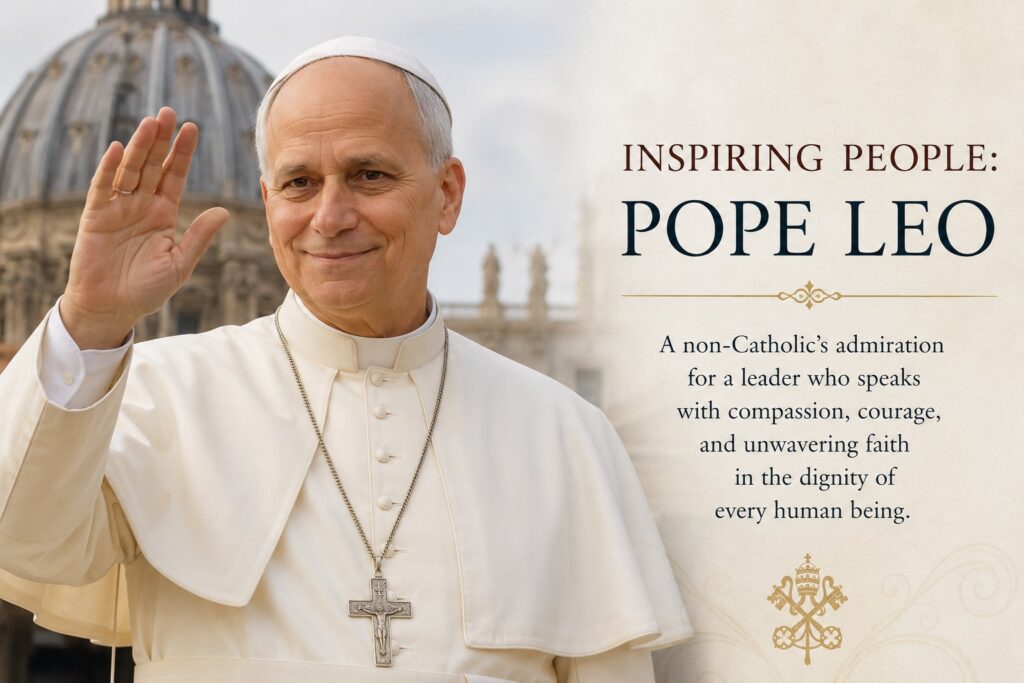
That is how I feel about Pope Leo.
As a non-Catholic, I do not look to a pope for doctrine. I look to him for evidence that compassion, humility, and moral courage still exist in positions of power. In a world increasingly dominated by anger, division, and the pursuit of personal gain, I find it refreshing to hear a leader speak about human dignity, service, and peace.
What inspires me most is not that Pope Leo appears willing to challenge political leaders. It is that he appears willing to challenge all of us. The Gospel message was never intended to make people comfortable. Jesus spoke repeatedly about caring for the poor, welcoming the stranger, helping the vulnerable, and treating others as we would wish to be treated. Those teachings are easy to quote and much harder to live.
When I listen to Pope Leo, I hear someone attempting to bring attention back to those fundamental principles.
I was equally inspired by Pope Francis, whose actions demonstrated a deep concern for people living on the margins of society. He reminded the world that faith is not merely something we profess. It is something we practice. The measure of our character is how we treat those with the least power.
What I admire about Pope Leo is that he seems determined to continue that tradition. He speaks about unity in a time of division. He speaks about peace in a time of conflict. He speaks about human worth in a culture that too often measures people by wealth, status, or political usefulness.
Whether one is Catholic, Protestant, Jewish, Muslim, atheist, or something else entirely, these are values that transcend religion. They speak to our common humanity.
I do not know Pope Leo personally. I cannot predict how history will judge his papacy. What I do know is that when I encounter someone who appears to be sincerely trying to elevate compassion over cruelty, service over self-interest, and hope over fear, I find that person inspiring.
In a world that often rewards the loudest voices, it is encouraging to see a leader who reminds us that kindness is not weakness, humility is not surrender, and caring for one another remains one of humanity’s greatest strengths.
For that reason, Pope Leo has earned a place in my Inspiring People category.
Not because he is Catholic.
Because he is striving to be Christ-like.