
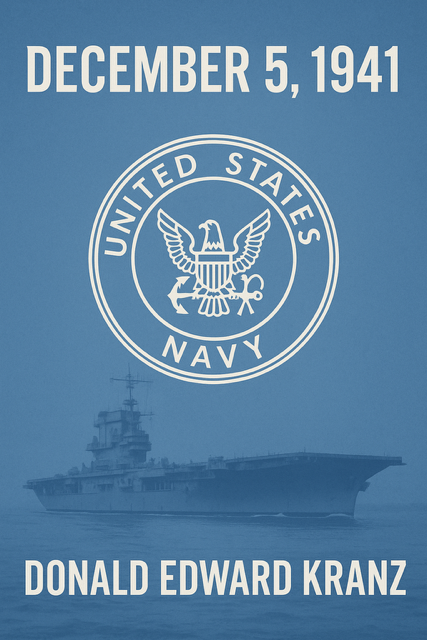
December 5, 1941, is a significant day in my family’s history, as it set the stage for the events that would change lives forever. December 5 has always held a quiet, powerful meaning in my family. On this day in 1941, just two days before the attack on Pearl Harbor, the USS Lexington CV-2 left the harbor carrying aircraft to Midway Island. My father, Donald Edward Kranz, was aboard that ship. He was a young man then, far from home but already deeply aware of the world-changing events unfolding around him. Without knowing it, he was also about to escape one of the most devastating attacks in American history.
Had the Lexington remained in port, it would almost certainly have been one of the targets. Instead, by order and by fate, it was already at sea.
For our family, December 5 is not just another date on the calendar. It is the quiet hinge on which my father’s life, and my own life that came after his, silently turned. Understanding this date’s significance helps us appreciate how individual moments can shape history and personal lives.
The Lexington’s Mission Before the Attack
In early December 1941, the U.S. Navy ordered the USS Lexington to leave Pearl Harbor on December 5 with a vital mission: delivering Marine aircraft to reinforce Midway Island, a strategic outpost in the Pacific. This mission was crucial because it aimed to strengthen defenses at Midway, which would later become a pivotal battleground in the Pacific War.
The Lexington sailed with several destroyers, forming Task Force 12. They moved northeast of Oahu, unaware that Japanese carrier groups were already closing in.
On December 7, while the task force was at sea, word of the attack reached them. The men aboard Lexington rushed to battle stations. My father, Donald Edward Kranz, was among them. I often imagine what he must have felt-his shock, fear for the sailors still in harbor, and the weight of knowing he was part of a historic moment that would test his courage and resolve.
The War in the Pacific: What Followed
The attack on Pearl Harbor marked the beginning of a brutal and wide-ranging conflict across the Pacific. The U.S. Navy suffered heavy losses. For months afterward, the Japanese Empire seemed unstoppable.
The early mission of the Lexington, delivering aircraft to Midway, proved vital. Six months later, in June 1942, the Battle of Midway became the turning point in the war. American cryptographers had broken the key Japanese codes. The U.S. Navy knew where the Japanese fleet would be and gained an advantage that changed the course of the war.
The Lexington played a central role in the early months of the conflict. Although the ship was lost in May 1942 during the Battle of the Coral Sea, the bravery of its crew helped secure the first major check on Japanese expansion. Those who served aboard her, including my father, carried a legacy of courage and duty.
Honoring My Father, Donald Edward Kranz
My father never forgot that December morning when fate carried the Lexington away from danger. Throughout his life, my Dad tried to ensure others felt gratitude and respect for those sacrifices. He shared stories about the men he served with, the sacrifices that marked those days, and the importance of understanding the history behind the freedoms we sometimes take for granted. This reflection aims to inspire gratitude and a sense of duty in the audience.
He spoke not only about the battles but also about the people. He remembered the sailors who did not have the same luck of timing. He honored the courage of those who fought in the long and difficult months that followed. To him, memory was a profound act of service, a way to honor those who did not come home, encouraging the audience to value remembrance.
Every year on December 5, I pause. I think of the young man standing on the deck of the Lexington, watching Pearl Harbor fade behind him, unaware of the events that would unfold two days later. I think of the future that waited for him, a family and a daughter, and generations he never had the chance to meet, all made possible because his ship sailed when it did.
A Closing Reflection
History is made up of dates, battles, and sweeping events, but it is also built from individual lives. It is made up of people like my Dad, who quietly did their duty. At the same time, the world around them changed, inspiring us to reflect on our own responsibilities.
Sharing this story is my way of continuing his mission to keep the past alive. It is a reminder of what happened, a way to honor the courage that shaped our world, and a moment to give thanks for the fragile and beautiful threads of timing that brought us all here.
Reference:
America and a Brief History of Her Wars | pearlharbor.org. https://pearlharbor.org/blog/american-brief-history-war/
Thank you for reading this blog post. If you have any questions or comments, please leave them in the Comments section below.
Copyright © 2019. I Don’t Know All The Answers, Nikki Mastro.
All of my photographs and documents are copyrighted.
Note: I used AI (ChatGPT) to create the main image for this Blog post.
No part of this website, including text, photographs, and documents, may be reproduced, stored in a retrieval system, or transmitted in any form or by any means without written permission from the copyright holder. All unauthorized use is strictly prohibited. If you choose to copy or share any information from my site, you must provide a link to the source. I appreciate your cooperation.
For further information concerning “I Don’t Know All The Answers.”
– Website and Blog: https://www.idontknowalltheanswers.com
– Facebook: https://www.facebook.com/Nikki.L.Mastro/
– Instagram: https://www.instagram.com/i_dont_know_all_the_answers/
– LinkedIn: https://www.linkedin.com/in/nikki-mastro-05455a3a/
– Youtube Channel: https://www.youtube.com/@idontknowalltheanswers1954