
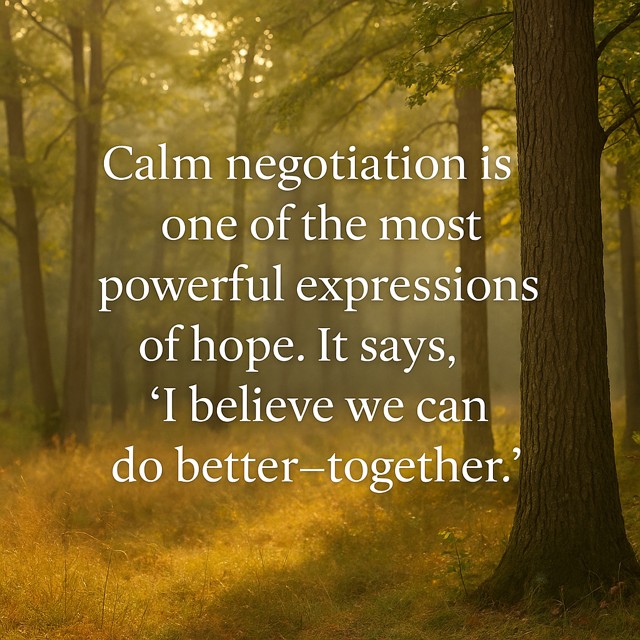
In times of disagreement, it can feel like shouting is the only way to be heard. But history, nature, and even our everyday experiences remind us that progress rarely happens through noise. It occurs through the powerful tool of calm, thoughtful negotiation, the art of listening, reasoning, and finding common ground even when the stakes are high. This is a tool that not only puts you in control but also empowers you to steer conversations toward understanding and resolution, instilling confidence in your abilities.
Proper negotiation is not about winning or losing. It is about understanding. It means stepping into a conversation not only to speak, but to listen. It requires patience, empathy, and respect for perspectives that differ from our own. When done well, negotiation builds bridges rather than burning them. It’s an art form, one that relies on calm, thoughtfulness, and a genuine desire to find common ground, instilling a sense of calm and composure in the face of conflict.
We see this principle at work in countless places. Parents use it with children. Teachers use it in classrooms. Even my golden retrievers, Teddy and Bear, have mastered their own version of negotiation. I have watched them trade toys, share space, and occasionally test boundaries, always with body language that says, “Let’s figure this out.” They remind me that, at its core, cooperation is about trust.
In human affairs, negotiation works best when people focus on shared goals instead of personal victories. When the intention shifts from “I must win” to “we must succeed,” doors begin to open. That kind of collaboration requires humility and courage, humility to admit we do not have all the answers, and courage to listen without fear of compromise. It unites us in a common purpose, fostering a spirit of cooperation.
Why Calm is Your Superpower
When we feel threatened or stressed, our body’s fight-or-flight response kicks in. Our heart rate increases, our thinking becomes narrow and reactive, and we lose access to the more creative, empathetic parts of our brain. This is the absolute worst state to be in during a negotiation. Reacting from a place of fear or anxiety almost guarantees a poor outcome. You might agree to something you’ll later regret, damage a relationship, or walk away from a perfect opportunity.
Staying calm, on the other hand, is like having a superpower. It allows you to remain centered and in control of your own emotions, regardless of what the other person is doing.
There is a significant power in tone. Calm communication can invite calm in return. When we approach disagreement with anger, we inadvertently feed division. However, when we approach it with steadiness, we create a safe space for others to engage. The best negotiators are often quiet thinkers who understand that clarity grows in stillness.
The Power of the Pause
One of the most effective tools I’ve learned is the power of the pause. When the other person says something that surprises or upsets you, the natural impulse is to react immediately. Instead, I’ve trained myself to take a deliberate breath. This small moment of silence does a few incredible things:
- It prevents an emotional reaction: It gives you a second to process the information and choose a thoughtful response rather than a knee-jerk one.
- It shows you’re listening: Pausing to consider what was said signals to the other person that you are taking them seriously.
- It can de-escalate tension: Silence can be a powerful tool to calm a heated room. It encourages everyone to slow down.
The Heart of Negotiation: Active Listening
We often think of negotiation as being about talking—making our case, stating our demands. But I’ve found that the most successful negotiators are actually the best listeners. Proper negotiation isn’t about convincing the other person you’re right; it’s about understanding what they truly need. This is where active listening comes in.
Active listening isn’t just waiting for your turn to talk. It’s about giving your full attention to the other person, both to what they’re saying and what they’re not saying.
Strategies for Better Listening
Here are a few practices that have helped me become a more active and empathetic listener:
- Listen to Understand, Not to Reply: Shift your focus from formulating your counter-argument to genuinely trying to grasp the other person’s perspective. What are their underlying concerns? What are their goals? What pressures are they facing?
- Paraphrase and Clarify: After they’ve spoken, summarize what you heard in your own words. You can use phrases like, “So, if I’m understanding correctly, your main concern is…” or “It sounds like the most important thing for you is…” This not only ensures you’ve understood them correctly but also makes them feel heard and validated.
- Ask Open-Ended Questions: Instead of questions that can be answered with a simple “yes” or “no,” ask questions that invite a more detailed response. For example, instead of asking, “Is the budget firm?” you could ask, “Can you walk me through the budget considerations for this project?” This opens the door to a more meaningful conversation.
Empathy: The Bridge to Common Ground
Once you start truly listening, you begin to develop empathy. You start to see the situation from the other person’s point of view. This doesn’t mean you have to agree with them, but it does mean you understand their position. Empathy is the bridge that connects two opposing sides, allowing them to find a path forward together and fostering a sense of connection and understanding.
Seeing the Person, Not the Position
It’s easy to get fixated on people’s stated positions. Thoughtful negotiation involves looking past the position to understand the underlying interest. When you know the “why,” you open up a world of creative solutions that can satisfy both parties.
Turning Theory into Practice
Developing the art of calm and thoughtful negotiation is a journey of personal growth. It’s about building self-awareness, emotional regulation, and a deeper connection with others. It’s a skill that extends far beyond the professional world, improving relationships with partners, family, and friends.
By staying calm, listening deeply, and leading with empathy, you can navigate any negotiation with confidence and grace, building stronger relationships and achieving better outcomes along the way.
Productive negotiation is not a weakness. It is a strength used wisely. It requires intelligence, emotional maturity, and foresight, the understanding that progress built on resentment will not last. When we work toward a win-win solution, we preserve dignity on all sides and create the space for lasting cooperation.
In moments of conflict, whether in families, workplaces, or government, we can all choose to be peacemakers. We can ask, “What do we share?” instead of, “What divides us?” It may take longer, but the outcome will be stronger, fairer, and more enduring.
A Closing Reflection
Calm negotiation is one of the most potent expressions of hope. It says, “I believe we can do better, together.” When we slow down and seek understanding, we honor the best part of our shared humanity. The goal is not to agree on everything, but to find a way forward that allows everyone to be heard.
Whether in the halls of leadership or around our own kitchen tables, the art of thoughtful negotiation reminds us that progress begins not with volume, but with respect.
Thank you for reading this blog post. If you have any questions or comments, please leave them in the Comments section below.
Copyright © 2019. I Don’t Know All The Answers, Nikki Mastro.
All of my photographs and documents are copyrighted.
No part of this website, including text, photographs, and documents, may be reproduced, stored in a retrieval system, or transmitted in any form or by any means without written permission from the copyright holder. All unauthorized use is strictly prohibited. If you choose to copy or share any information from my site, you must provide a link to the source. I appreciate your cooperation.
For further information concerning “I Don’t Know All The Answers.”
– Website and Blog: https://www.idontknowalltheanswers.com
– Facebook: https://www.facebook.com/Nikki.L.Mastro/
– Instagram: https://www.instagram.com/i_dont_know_all_the_answers/
– LinkedIn: https://www.linkedin.com/in/nikki-mastro-05455a3a/
– Youtube Channel: https://www.youtube.com/@idontknowalltheanswers1954