There are moments in life that stay frozen in your memory forever, and I want to share this one today, because it’s Endangered Species Day.
As I just said, some memories stay frozen forever, not because they were peaceful or beautiful. However, this one began that way, but suddenly, in a matter of seconds, the quiet truth about nature and human responsibility becomes impossible to ignore.
One morning in Arnold, Teddy and I were sitting quietly on the deck, enjoying the sunrise. Those mountain mornings had a stillness to them that felt almost sacred. The trees moved softly in the breeze, the light filtered through the pines, and for a little while, the world felt calm.
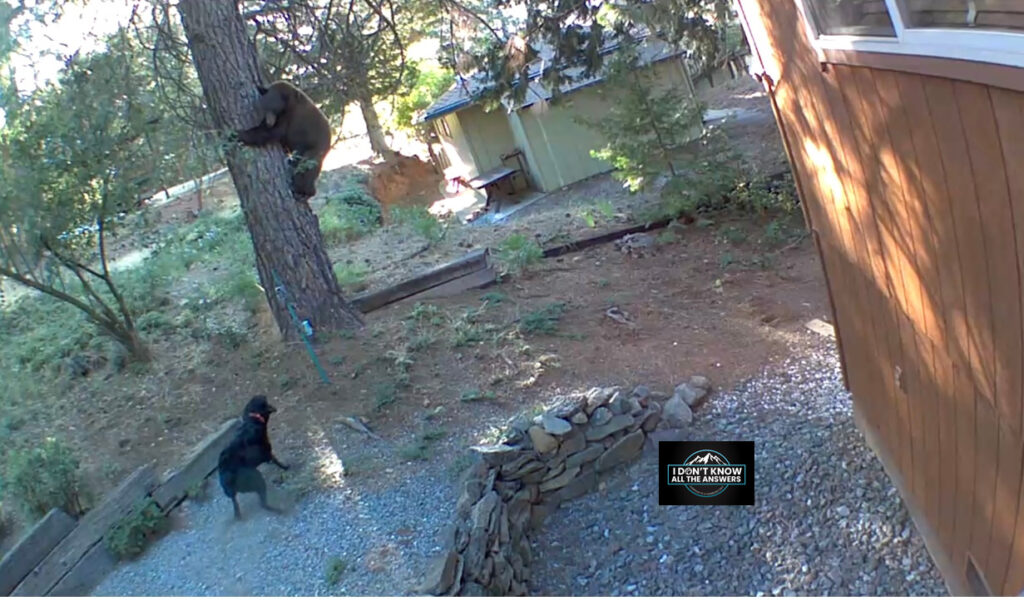
Then we heard barking. Not ordinary barking. This was frantic, aggressive, determined barking moving rapidly toward us through the trees. Before I could fully process what was happening, a black bear came running into view and climbed a nearby tree directly in front of us. Right behind it, a black dog barking ferociously stopped at the base of the tree. The bear clung to the trunk, trying to escape the confrontation. The dog barked wildly below.
And Teddy? Teddy watched. That was Teddy. He was never a reckless reactor. He observed first. He assessed. Occasionally, if another dog truly crossed a line, he would respond, but most of the time, he studied the world around him with those thoughtful eyes of his.
So while I was internally panicking, Teddy sat quietly beside me, watching this entire scene unfold.
Oddly enough, my fear and anger were not centered on the bear. Nor was it centered on the dog. My anger was directed at the person responsible for creating the situation in the first place. The dog was not “bad.” It was being a dog. The bear was not “bad.” It was doing exactly what black bears often do to avoid conflict. It fled upward. It tried to create distance.
The failure was the irresponsible human being who allowed a dog to run loose in bear country without understanding the danger it posed to both animals.
Eventually, the dog retreated, and the bear slowly climbed down and calmly walked away as though this interruption had become another unpleasant part of surviving near humans.
But the experience stayed with me.
Later, I learned the dog belonged to a man living somewhere nearby. I never learned his name or address, though I eventually discovered the dog had been on my property multiple times, meaning he lived fairly close. I remember feeling deeply frustrated because living in mountain communities requires a different mindset than many people realize.
You are not moving into nature as its ruler. You are moving into someone else’s habitat. That reality comes with responsibility.
Protecting wildlife also means protecting pets from situations they cannot fully understand. A loose dog chasing a bear may feel exciting or instinctive to the dog, but the outcome can become tragic in seconds. Bears can injure dogs. Dogs can provoke defensive reactions. Humans can escalate situations that never needed to happen in the first place.
What struck me most over the years I lived in Arnold was that the wildlife usually tried much harder to coexist peacefully than many humans did.
The bears mostly wanted food, distance, and safety.
The deer passed quietly through.
The bobcats slipped silently through the shadows.
Even the mountain lions generally wanted nothing to do with us.
Most wildlife conflicts begin long before the animal appears. It begins with human carelessness, arrogance, or refusal to respect boundaries.
Living there changed me.
It taught me that I wasn’t simply someone who loved animals. I was a wildlife enthusiast, a photographer, and someone deeply committed to coexistence. Looking back now, I sometimes think my childhood love of teddy bears quietly evolved into a love for the real thing and a desire to protect them.
I miss Arnold. I miss the trees, the morning quiet, the wildlife encounters, and the feeling that nature still surrounds everyday life. But I also recognize that where we are now is better for everyone in my immediate family.
Some chapters of life are meant to shape us, not hold us forever.
Arnold gave me memories, perspective, and a respect for the natural world that I still carry with me.
And every time I look at that photograph of the bear clinging to the tree while Teddy quietly watched beside me, I’m reminded of something important:
Nature is not the enemy. Irresponsibility is.