
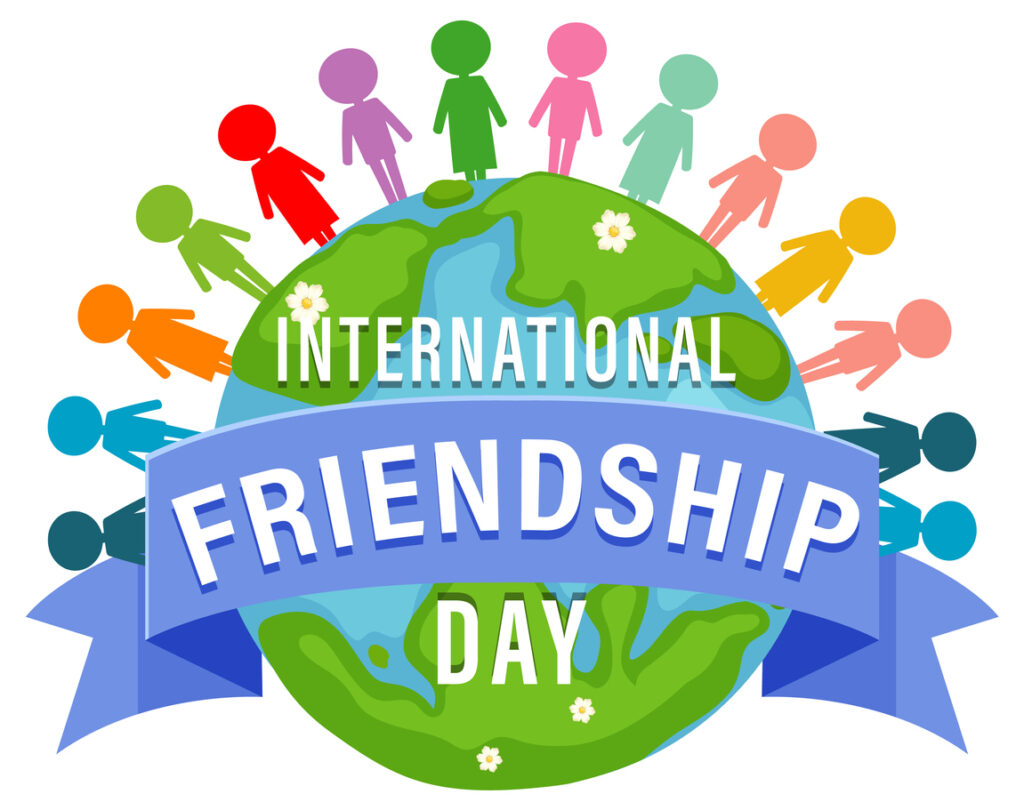
I’m late recognizing International Friendship Day this year, since I’ve been preoccupied with wildfires, earthquakes, and several other things that have required my attention. Yet friendship is one of those topics which ought not to be regarded as something too late to discuss; on the contrary, given all that is going on in the world, it might be more important than ever for us to talk about friendship.
The International Day of Friendship was officially established by the United Nations General Assembly in 2011. The aim of the day was not merely to encourage us to telephone an old friend or send somebody a card. The United Nations acknowledged that friendship among individuals, peoples, countries and cultures could motivate actions aimed at achieving peace and help to build links between different communities.
I love that idea.
However, friendship can exceed that.
The term friendship also refers to the way we deal with another human being.
We live in a world in which we are continually reminded of our differences. People are divided by nationality, religion, race, politics, language, culture, and many other criteria. While some of these differences are essential elements of our identities and must therefore be respected, trouble arises when such differences lead to fear, distrust, or the dehumanization of one another.
Friendship requires us to adopt a different attitude. It requires us to be interested in another person rather than suspicious of them. It asks that we listen before forming an opinion. It requires us to realize that someone who lives thousands of miles away, speaks a different language, and follows traditions that we are entirely unfamiliar with, still cares about their children, grieves when someone they love dies, wants to feel safe, and hopes that tomorrow will be better.
The stranger is no longer quite so unusual a person.
That could be one of the most important significances of International Friendship Day.
The United Nations regards friendship as one of the means by which we can promote solidarity, mutual understanding and reconciliation; it especially encourages young people to take part in activities that involve different cultures so that future generations come to respect diversity rather than fear it. (International Day of Friendship, 2011)
What might occur if we took that seriously?
We can’t resolve international conflicts by ourselves since most of us will never have the opportunity to sit at a diplomatic negotiating table or take part in a peace conference. Yet every one of us takes part in something on a much smaller scale every day, namely in the way we treat people nearby.
We can get in touch with people whose experiences differ from our own. Instead of depending on stereotypes, we can learn about another culture. We can choose not to take part when people are merely given insulting labels. We can travel, read, listen, and ask questions. We can teach our children and our grandchildren that differences do not automatically mean someone is dangerous or wrong.
And above all else, we can make friends.
- They have a name.
- They have a story.
- They have those people they love.
- We see them as human.
Which is why a day dedicated to friendship should receive more attention than it often does. Although friendship may seem mild, it possesses great strength. It is capable of crossing a political border, of spanning an ocean, and of crossing generations, cultures, religions, and languages. It can challenge the assumptions which we have held for years.
Right now, when so much of the world is trying to tell us whom to fear, friendship is a quiet act of resistance.
It is possible to care for one another without agreeing on all things. There is no need to give up our own beliefs to listen to someone else with respect. Nor do we have to be the same to recognize our common humanity.
- It can start with a conversation.
- It may start with a sense of curiosity.
- It may start when we stop seeing a stranger and start seeing someone who could become a friend.
References
Thank you for reading this blog post. If you have any questions or comments, please leave them in the Comments section below.
Copyright © 2019. I Don’t Know All The Answers, Nikki Mastro.
All of my photographs and documents are copyrighted.
The main photo included in this blog post is from the iStock.com library.
No part of this website, including text, photographs, and documents, may be reproduced, stored in a retrieval system, or transmitted in any form or by any means without written permission from the copyright holder. All unauthorized use is strictly prohibited. If you choose to copy or share any information from my site, you must provide a link to the source. I appreciate your cooperation.
For further information concerning “I Don’t Know All The Answers.”
– Website and Blog: https://www.idontknowalltheanswers.com
– Facebook: https://www.facebook.com/Nikki.L.Mastro/
– Instagram: https://www.instagram.com/i_dont_know_all_the_answers/
– LinkedIn: https://www.linkedin.com/in/nikki-mastro-05455a3a/
– YouTube Channel: https://www.youtube.com/@idontknowalltheanswers1954