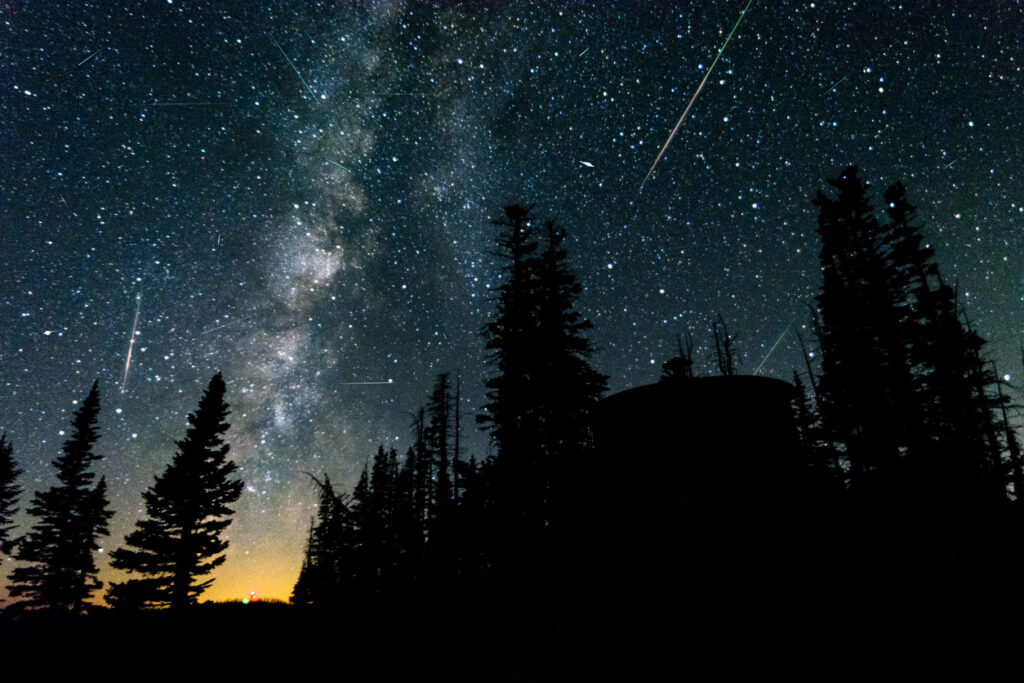
The Perseids occur each year as the Earth passes through the debris left by Comet 109P/Swift-Tuttle. When these small particles enter our atmosphere at high speeds, they heat up and produce flashes of light we call meteors, or “shooting stars.”
A good aspect of the Perseids is that special equipment is not necessary if you want to enjoy them; you don’t need a telescope at all. On the contrary, using a telescope can, in fact, stop you from seeing anything. The best way to watch a meteor shower is with your own eyes; this way, you can see as much of the sky as possible.
I can tell from experience just how much your location can affect the experience.
While I lived in Arnold, California, among the Sierra Nevada mountains and far from any city lights, the night sky was fantastic. On certain occasions, I would look up and be amazed at the number of stars that were visible. It was a sky that made you understand just how vast the universe is and how small we are in comparison.
Being in the valley now is quite a change. Light pollution has made it difficult to see many of the stars I used to see. Although I am still able to look upwards, I really long for the dark skies in Arnold.
The Perseids are named after the constellation Perseus since the meteors appear to originate in that area of the sky. However, you don’t need to look for Perseus to see the display. Simply go to the darkest place you can safely get to, let your eyes adjust to the dark, take your phone with you, and then look up. Then be patient.
It’s not like switching on a TV program at a fixed time to watch it. You could look into the dark for a few minutes and see nothing at all, and then suddenly a streak of light shoots across the sky and disappears just as quickly.
That might be one reason it is so special. For a single moment, something that traveled through our solar system appears and then disappears forever.
The Perseids also provide us with something rare in our busy lives: a reason to stop for a moment. To step outside. To switch off the screens. So that our eyes can get used to the dark, and look up.
I may no longer have the beautiful Arnold sky outside my window, and I don’t have a telescope, but that doesn’t stop me from taking part in something people have been doing for thousands of years.
I can still stand out under the night sky, look for a flash of light, and feel a sense of wonder.
The universe sometimes puts on an amazing show.
We need to remember to look up.
References: