
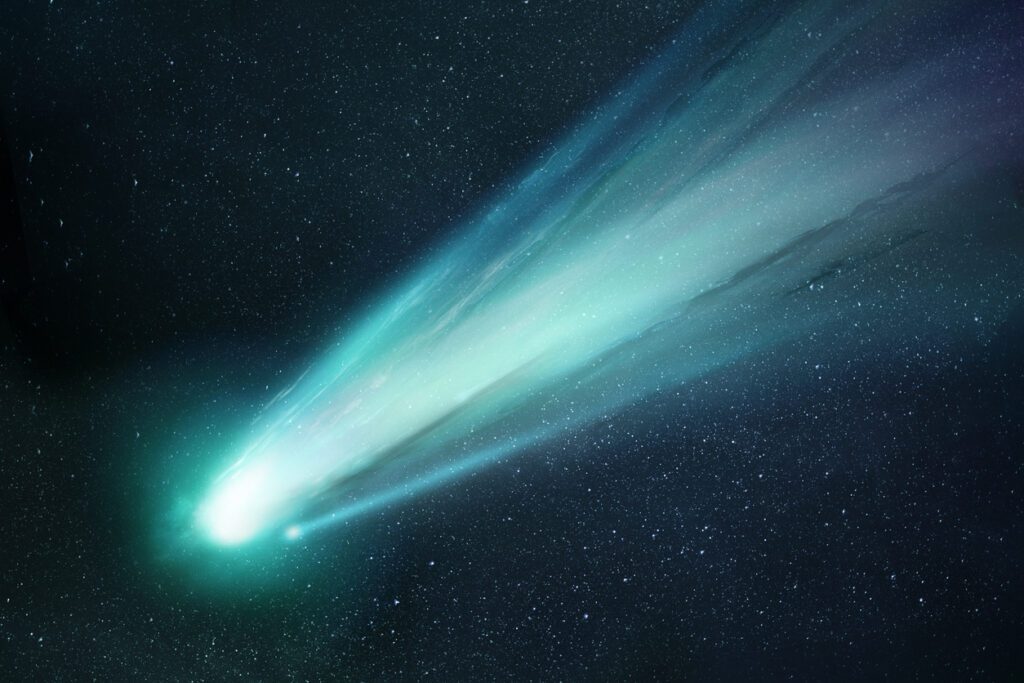
Note: the main image in this blog post is not of 3I/Atlas. It is a photo of a Comet available on iStock.com
Have you heard about 3I/Atlas and wondered what it was? Me too. Here’s what I have learned about the mysterious 3I/Atlas.
Every so often, the vast quiet of space sends us a messenger, a wanderer from another star system, a fragment of some ancient world long gone cold. In July 2025, astronomers detected one such traveler, now known as 3I/ATLAS, the third confirmed interstellar object ever found passing through our solar system. Its journey, a testament to the vastness and complexity of our universe, is expanding our knowledge in ways we could never have imagined.
Note: For a more detailed description, pictures, and analysis, please see Wikipedia. 3I/Atlas. https://en.wikipedia.org/wiki/3I/ATLAS
Its name may sound technical, but its meaning is simple and extraordinary. “3I” means it is the third interstellar object ever identified, the others being 1I/ʻOumuamua in 2017 and 2I/Borisov in 2019, and “ATLAS” refers to the telescope system in Chile that first spotted it.
What makes 3I/ATLAS remarkable is not just that it came from beyond our Sun’s reach, but that it carries with it the chemistry, the age, and perhaps even the story of another solar system entirely.
A Messenger from Afar
When astronomers calculated the path of this faint, glowing object, they realized it was moving too fast to be bound by the Sun’s gravity, roughly 130,000 miles per hour. Its orbit is hyperbolic, meaning it did not originate here and will not remain. It is simply passing through, an interstellar visitor on its way back to the great dark between the stars.
Like many comets, it carries a halo of gas and dust, a soft, luminous envelope called a coma, formed as sunlight warms its icy core. But scientists quickly noticed something odd. 3I/ATLAS seemed unusually rich in carbon dioxide, far more than typical comets in our solar system. This single clue suggests it may have formed in a colder, more distant region around another star. In this place, sunlight was weak, and the chemistry of ice was different from our own beginnings.
In other words, 3I/ATLAS is not just a comet. It is a frozen relic of another world’s creation.
Older Than Our Own Comets
Some astronomers believe 3I/ATLAS could be older than any comet we have ever studied. It may have been drifting through interstellar space for billions of years, since before Earth itself took shape. Over that time, it has been bombarded by cosmic rays, micrometeoroids, and unfiltered starlight, slowly reshaping its surface into something almost timeless.
When telescopes like the Hubble Space Telescope and the James Webb Space Telescope turned their gaze toward it, they confirmed what many hoped: water ice, carbon monoxide, and carbon dioxide, the same fundamental materials that helped form planets and eventually life.
For scientists, this is like holding a piece of another solar system in our hands, a time capsule from a place we can never visit.
A Question of Nature or Intention
As 3I/ATLAS approaches the Sun, a fascinating scientific debate unfolds. In a recent interview, Dr. Michio Kaku, a respected physicist, highlighted a genuine divide among scientists over the nature of this interstellar object.
One group sees 3I/ATLAS as a highly interesting yet natural comet, a visitor propelled only by sunlight and outgassing, behaving according to the laws of physics as we understand them. The other group wonders if it could be something more, an intelligently controlled device, perhaps sent to explore or observe.
Dr. Kaku noted that the crucial moment will come around October 29, when 3I/ATLAS rounds the Sun. Scientists will be observing for any sign of abnormal propulsion, a movement inconsistent with known physical forces, that might hint at something extraordinary.
For most astronomers, the natural explanation remains far more likely. Yet the fact that serious scientists are even open to testing this possibility shows how mysterious this object truly is and how far our curiosity extends.
No Threat, Only Wonder
Despite its exotic origin, 3I/ATLAS poses no danger to Earth. It will pass by safely, its closest approach occurring as it nears the Sun in late October 2025. As it warms, it may brighten, forming a shimmering tail of gas and dust, a visible signature of its farewell journey. If conditions are right, amateur astronomers with good telescopes may even catch a glimpse of it before it disappears forever into deep space.
For most of us, though, its beauty lies not in what we can see, but in what it represents, a reminder that our solar system is not isolated, that the space between the stars is not empty, and that worlds beyond our own have left their fingerprints on the universe we share.
What It Teaches Us
Each of these rare visitors, 1I/ʻOumuamua, 2I/Borisov, and now 3I/ATLAS, gives us a new piece of a larger cosmic puzzle. The discovery and study of 3I/ATLAS is a significant step in our understanding of the universe and our place within it.
- 1I/ʻOumuamua was small, rocky, and oddly shaped, moving like a shard of something broken.
- 2I/Borisov looked more like a traditional comet, made of familiar ices and dust.
- 3I/ATLAS, however, seems to blend both worlds, rich in frozen gases but unusually composed, as though shaped by a different kind of star.
Together, they whisper the same truth. Our galaxy is not a collection of isolated systems but a web of shared material where dust, ice, and rock are exchanged across light-years. Each interstellar object we find is proof that our own beginnings were part of something much larger, a galactic story still unfolding.
A Moment to Reflect
It is easy to think of astronomy as distant and technical, all numbers, data, and instruments. But 3I/ATLAS reminds us that science can also be deeply human. There is a quiet poetry in the idea that a grain of ice formed around another sun billions of years ago has wandered across the gulf of space only to be seen, for a brief moment, by the eyes of humankind.
Whether 3I/ATLAS proves to be a natural comet or something more mysterious, its arrival invites us to look up, not in fear but in awe, and to remember that even across the emptiest distances, the universe still finds ways to send us wonder.
References:
Wikipedia. 3I/Atlas. https://en.wikipedia.org/wiki/3I/ATLAS
Wikipedia. Michio Kaku. https://en.wikipedia.org/wiki/Michio_Kaku
Curious stories of coexistence – TED Radio Hour notes and takeaways. https://podpulse.ai/podcast-notes-and-takeaways/ted-radio-hour-curious-stories-of-coexistence
Thank you for reading this blog post. If you have any questions or comments, please leave them in the Comments section below.
Copyright © 2019. I Don’t Know All The Answers, Nikki Mastro.
All of my photographs and documents are copyrighted.
The main photo included in this blog post is from the iStock.com library.
- Comet Neowise Close Up Passing The Sun stock photo
Stock photo ID:1257847324
Upload date: July 30, 2020
Location: United Kingdom
No part of this website, including text, photographs, and documents, may be reproduced, stored in a retrieval system, or transmitted in any form or by any means without written permission from the copyright holder. All unauthorized use is strictly prohibited. If you choose to copy or share any information from my site, you must provide a link to the source. I appreciate your cooperation.
For further information concerning “I Don’t Know All The Answers.”
– Website and Blog: https://www.idontknowalltheanswers.com
– Facebook: https://www.facebook.com/Nikki.L.Mastro/
– Instagram: https://www.instagram.com/i_dont_know_all_the_answers/
– LinkedIn: https://www.linkedin.com/in/nikki-mastro-05455a3a/
– Youtube Channel: https://www.youtube.com/@idontknowalltheanswers1954
I used to be more than happy to search out this net-site.I wanted to thanks on your time for this glorious read!! I undoubtedly enjoying each little bit of it and I’ve you bookmarked to take a look at new stuff you blog post.