
Sometimes the sweetest moments arrive completely unannounced.
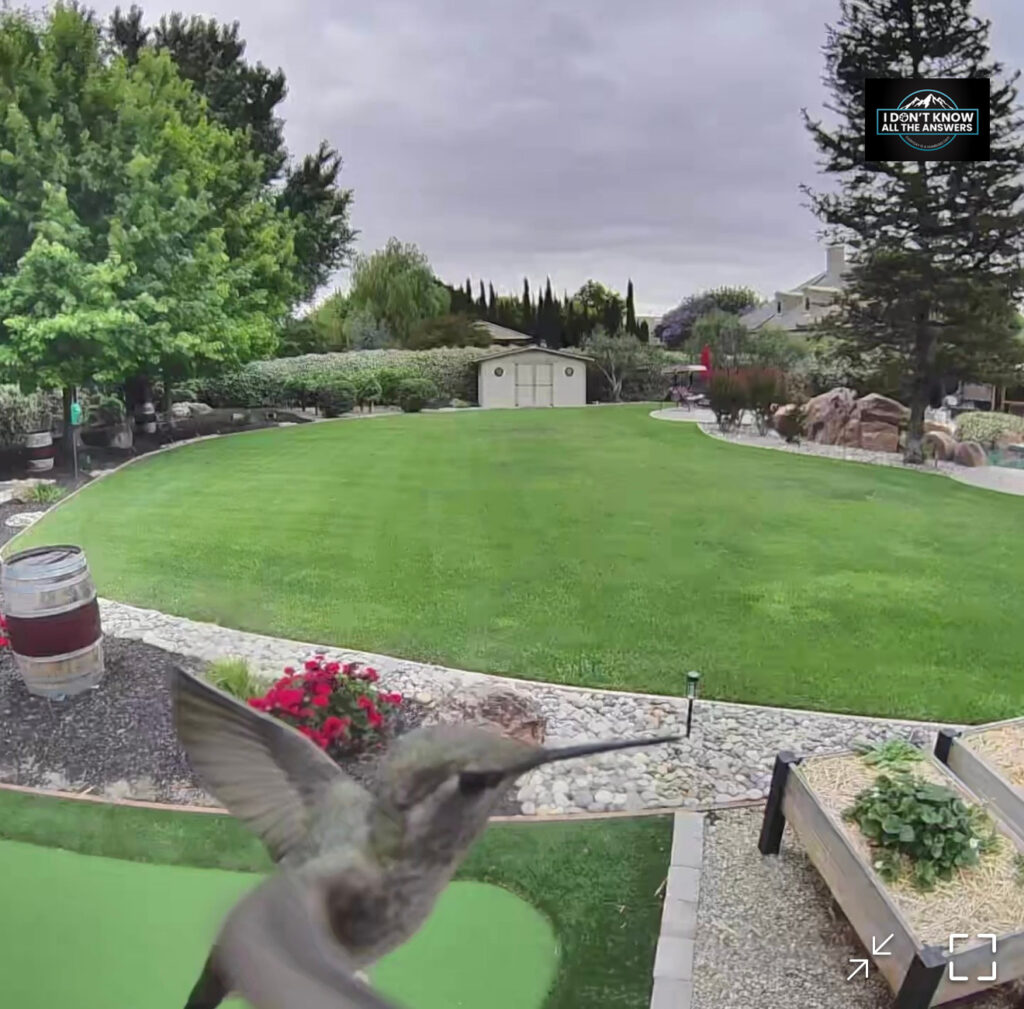
I originally installed cameras around our backyard to photograph nighttime visitors. Over the years, they have captured raccoons, possums, skunks, wandering cats, Gray Foxes, and all sorts of unexpected guests moving quietly through the dark. But recently, one of my daytime cameras surprised me with something entirely different.
Not in the distance. Not perched on a branch far away. This tiny little visitor flew directly up to the camera lens as if he wanted to inspect the situation personally. For one suspended second, the camera captured his delicate wings, tiny beak, and soft gray feathers against the backdrop of the yard.
And honestly, it felt like a gift.
What makes the moment even more special is that I do not keep hummingbird feeders in this area. No bright red sugar stations are hanging nearby. Instead, this little bird was drawn naturally to the flowering plants and peaceful environment surrounding the greenhouse and garden beds.
Hummingbirds Love Color and Shape
- Red
- Orange
- Pink
- Deep coral
- Purple
Interestingly, they are not drawn to fragrance the way bees often are. Their eyesight is extraordinary, and they are highly visual creatures. They notice bright, tubular flowers that their long beaks can reach to reach nectar deep inside the bloom.
- Salvia
- Fuchsia
- Honeysuckle
- Petunias
- Bee balm
- Trumpet vine
- Penstemon
- Columbine
- Geraniums, I love Geraniums and have them all over my yard.
- Lantana, I have hanging baskets of Lantana at the front of the greenhouse.
Tiny Birds With Incredible Abilities
A hummingbird’s wings can beat anywhere from 50 to 80 times per second. Some species can even fly backward, hover perfectly still, and instantly change direction in midair.
Their hearts beat incredibly fast as well, often over 1,000 beats per minute during intense activity.
They Are Surprisingly Territorial
They are extremely territorial and protective of food sources. A hummingbird may repeatedly chase away birds much larger than itself if it decides an area belongs to them.
How Long Do Hummingbirds Live?
Because they move so quickly and seem almost magical, many people assume hummingbirds have very short lives. Some do not survive their first year due to predators, storms, or migration challenges, but those that do can live much longer than expected.
Many hummingbirds live 3 to 5 years, and some have been documented living over 9 years in the wild.
Creating a Natural Hummingbird Haven
The nicest part about attracting hummingbirds naturally is that it often benefits the entire garden.
Flowering plants provide nectar, shrubs offer resting places, and trees create shelter from predators and wind. Even shallow water sources or gentle misters can attract them during warm weather.
In many ways, hummingbirds seem to prefer gardens that feel safe, layered, colorful, and alive.
Perhaps that is why this little visitor stopped by.
Not because of sugar water.
Coffee Thoughts
- Tiny wings.
- Tiny heartbeat.
- Tiny visitor.
Thank you for reading this blog post. If you have any questions or comments, please leave them in the Comments section below.
Copyright © 2019. I Don’t Know All The Answers, Nikki Mastro.
All of my photographs and documents are copyrighted.
No part of this website, including text, photographs, and documents, may be reproduced, stored in a retrieval system, or transmitted in any form or by any means without written permission from the copyright holder. All unauthorized use is strictly prohibited. If you choose to copy or share any information from my site, you must provide a link to the source. I appreciate your cooperation.
For further information concerning “I Don’t Know All The Answers.”
– Website and Blog: https://www.idontknowalltheanswers.com
– Facebook: https://www.facebook.com/Nikki.L.Mastro/
– Instagram: https://www.instagram.com/i_dont_know_all_the_answers/
– LinkedIn: https://www.linkedin.com/in/nikki-mastro-05455a3a/
– Youtube Channel: https://www.youtube.com/@idontknowalltheanswers1954